
Event Staff Housing in Las Vegas: How to House 100 Workers Without Blowing Your Budget
Housing 100 temporary workers in Las Vegas is a very different challenge from booking accommodation for a small business trip. A major convention, trade show, corporate event, entertainment production, sporting event, or multi-day activation can require dozens or even hundreds of employees to arrive on different dates, work different shifts, and stay for different lengths of time.
The challenge is not simply finding 100 beds. An effective event staff housing plan must balance accommodation costs with location, occupancy, transportation, comfort, scheduling, and flexibility.
Las Vegas is a major destination for conventions, exhibitions, entertainment, and corporate events, so temporary workforces may need housing for everything from a few days to several weeks or longer. Planning accommodation around the actual workforce rather than choosing properties first can make the process considerably easier.
Start With the Workforce, Not the Property
Before contacting hotels, furnished housing providers, or other accommodation options, establish exactly who needs to stay in Las Vegas.
A workforce of 100 does not necessarily mean 100 individual rooms. Depending on company policies, employee preferences, and the type of assignment, workers may be accommodated through a combination of individual rooms, shared accommodations, furnished apartments, or homes.
For example, the group might include:
- 100 temporary event workers
- 80 workers and 10 supervisors
- Staff arriving on different dates
- Teams working different shifts
- Setup and breakdown crews
- Workers staying for only part of the event
- Employees traveling with spouses or family members
These differences directly affect the number of bedrooms, units, nights, and transportation arrangements required.
Create a simple housing spreadsheet before searching for properties. Record each employee’s arrival date, departure date, role or team, preferred occupancy arrangement, transportation requirements, and relevant accommodation needs.
This turns “we need housing for 100 people” into a detailed accommodation plan that providers can actually work with.
Calculate the Total Cost Per Worker
One of the biggest mistakes in large-group event accommodation is focusing exclusively on the advertised room rate.
The property with the lowest nightly price may not produce the lowest overall cost. For a workforce of 100, transportation, meals, parking, utilities, cleaning, deposits, and changes to the reservation can significantly affect the final budget.
When comparing options, consider:
- Accommodation rate
- Utilities, if not included
- Internet
- Parking
- Cleaning or housekeeping
- Deposits and additional fees
- Transportation to and from the venue
- Travel time
- Meal costs
- Costs associated with extending or changing the stay
A property that costs slightly more but is substantially easier for workers to reach may reduce shuttle requirements and commuting expenses.
Similarly, furnished accommodation with kitchen facilities can give longer-term workers the ability to prepare meals instead of relying entirely on restaurants or takeout.
The number that matters is the all-in cost of housing the workforce, not simply the advertised nightly rate.
Match Housing to the Length of the Event Assignment
Not every event staff member needs the same accommodation period.
Some employees may arrive shortly before the event and leave immediately afterward. Others may need to be in Las Vegas early for venue preparation, rehearsals, equipment installation, training, or production work.
For short assignments, hotels can be practical because they simplify check-in, housekeeping, and short-term occupancy.
For longer assignments, however, furnished housing deserves closer consideration.
When Furnished Housing Makes Sense
Furnished homes and apartments can be useful when workers need accommodation for several weeks or a month or longer. Instead of arranging furniture, household essentials, and utilities separately, employees can move into an already furnished environment.
Izeal Stay specializes in furnished homes and apartments for 30-night-or-longer stays, making this type of accommodation relevant when event-related work extends beyond a conventional hotel stay. Its workforce housing service is designed for longer temporary accommodation needs involving workers and project teams.
The appropriate arrangement will depend on the property’s occupancy rules, availability, bedroom configuration, and the organization’s requirements.
Group Workers by Their Schedule
A useful way to control event staff housing costs is to organize employees according to when they actually need accommodation.
Imagine 100 workers are involved in an event, but only 70 are required throughout the entire assignment. The remaining 30 may handle registration, setup, hospitality, transportation, technical work, or post-event breakdown.
Paying for identical accommodation for all 100 people for the entire project could create unnecessary costs.
Instead, divide the workforce into groups.
Core Event Team
These are employees who remain in Las Vegas for most or all of the project. Their accommodation should generally be secured first because they require the longest stay.
Event-Period Staff
These employees arrive shortly before the event and leave after the final event day. Their accommodation period may be considerably shorter.
Setup and Breakdown Teams
Production and operations employees may need to arrive before attendees and remain after the event ends. Their housing dates should be planned independently from front-of-house or guest-facing staff.
This schedule-based approach can reduce unnecessary accommodation nights while making the overall booking easier to manage.
Choose the Location Based on the Actual Las Vegas Venue
Location matters enormously when housing a large temporary workforce.
A property can appear close to a venue on a map while still creating a difficult commute during busy periods. For 100 workers, even a modest transportation problem can become an operational issue.
Evaluate accommodation based on actual travel time during staff shift hours, rather than distance alone.
Ask:
- How long will workers take to reach the venue?
- Can employees travel independently?
- Is parking available?
- Would shared transportation be practical?
- Are grocery stores and pharmacies nearby?
- Are restaurants accessible after late shifts?
- Will the commute work for early-morning setup crews?
- Can transportation operate efficiently after the main event ends?
For a large workforce, a location that simplifies daily transportation may be more valuable than a small difference in the accommodation rate.
Compare Workforce Housing With Individual Hotel Rooms
Booking 100 individual hotel rooms may seem like the easiest solution, particularly for a short event. But it may not be the most practical option for a longer assignment.
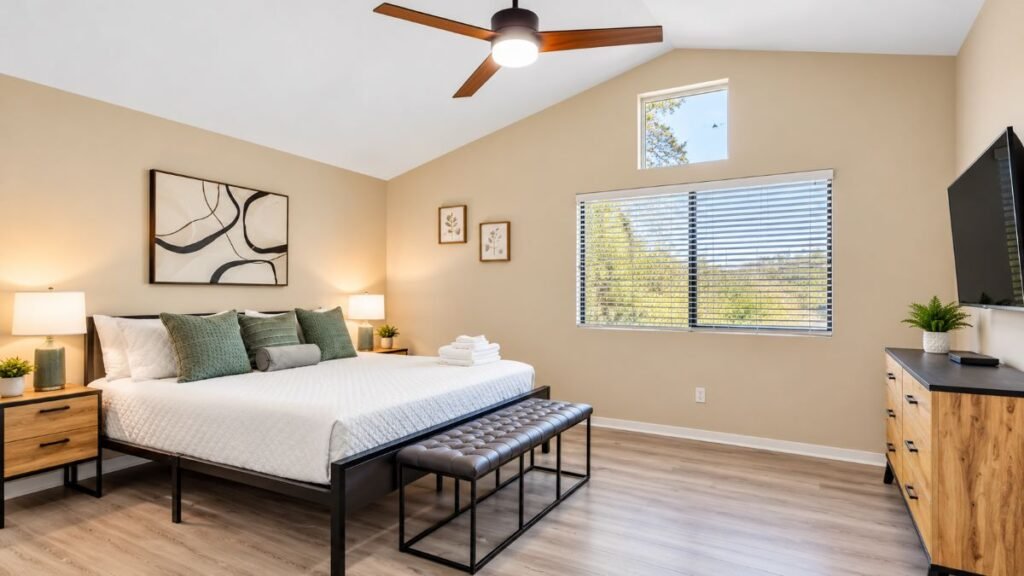
Furnished apartments and homes can provide bedrooms, living areas, kitchens, and laundry facilities, depending on the property. This can give workers a more residential environment when they are away from home for an extended period.
Izeal Stay’s furnished apartments and homes can be considered when an organization wants move-in-ready accommodation rather than simply individual hotel rooms.
That does not mean shared housing is automatically better. Employers should consider privacy requirements, company policies, employee preferences, occupancy limits, and the property’s specific configuration before deciding.
The objective is to find the arrangement that provides the right balance between cost, comfort, and operational simplicity.
Build a Manageable Housing Plan for 100 Workers
Large group accommodation should be organized carefully from the beginning.
Rather than treating 100 employees as one enormous reservation, divide them into manageable groups based on operational needs.
Possible categories include:
- Department
- Shift
- Supervisor
- Arrival date
- Work assignment
- Accommodation location
- Transportation group
This approach makes check-in easier and helps managers quickly identify where each employee is staying.
Maintain one master housing record with:
- Property address
- Employee names
- Contact information
- Arrival and departure dates
- Unit or room assignments
- Parking information
- Property rules
- Check-in instructions
- Emergency procedures
- Housing provider contact details
A centralized record becomes especially valuable when someone changes shifts, arrives late, leaves early, or needs an extension.
Plan Transportation and Housing Together
Accommodation and transportation should never be treated as completely separate decisions.
If 100 workers are spread across multiple properties, the company must determine how they will reach the venue every day. A seemingly inexpensive housing arrangement can become considerably more expensive if it requires several shuttle routes.
Conversely, placing workers in a smaller number of strategically located properties may make shared transportation easier.
Shift schedules matter, too. Event workers may start early for setup, finish late after an event, or work overnight during production and breakdown.
Create a transportation plan showing:
- Where each employee or team is staying
- Which workers share transportation
- Pickup and drop-off locations
- Shift times
- Expected travel times
- Backup arrangements for schedule changes
The housing plan should therefore include a transportation map, not merely a list of addresses.
Look for Flexible Extended-Stay Accommodation
Event schedules can change.
A convention may add another day. A production may be delayed. Venue preparation may take longer than expected. An activation could be extended.
For that reason, flexibility should be evaluated before workers move into the property.
Ask the housing provider:
- Can the stay be extended?
- What happens if the number of workers changes?
- How much advance notice is required?
- Is the same unit guaranteed if the project runs longer?
- How are extension rates handled?
- What happens if an employee leaves earlier than planned?
Izeal Stay’s extended-stay housing provides furnished accommodation for longer temporary stays, with properties that may include practical residential features such as kitchens, laundry facilities, utilities, Wi-Fi, and furnished living areas. Specific amenities and availability should always be confirmed for the property being considered.
Consider Special Housing Requirements
Not every worker has identical accommodation needs.
Some employees may require a private bedroom. Others may be comfortable with shared arrangements. Workers traveling with family members may need additional bedrooms and living space.
There may also be requirements related to parking, accessibility, pets, work schedules, or proximity to specific locations.
Ask about these requirements before finalizing the accommodation plan rather than trying to solve them after everyone has arrived.
If an employee’s normal residence is temporarily unavailable because of damage, restoration, or another housing disruption, insurance housing may provide a separate temporary accommodation solution.
The broader lesson is simple: choose accommodation based on the reason for the stay and the actual needs of the people using it.
100-Worker Event Housing Checklist
Before committing to accommodation, review the following:
| Planning Area | Questions to Answer |
| Headcount | How many workers actually require housing? |
| Dates | When does each employee arrive and leave? |
| Occupancy | Who can share, and how many bedrooms are required? |
| Location | How practical is the commute to the event venue? |
| Transportation | Can workers travel efficiently during every shift? |
| Amenities | Are Wi-Fi, kitchens, laundry, parking, and essentials available? |
| Budget | What is the all-in cost per worker? |
| Flexibility | Can dates or headcount change if the event schedule changes? |
| Management | Who handles check-in, changes, and employee questions? |
For a 100-person workforce, documenting these details before booking can prevent expensive logistical problems later.
The Best Budget Strategy Is Not Always the Lowest Rate
Trying to reduce the accommodation rate as much as possible can sometimes create higher costs elsewhere.
A cheaper property may require more transportation. Multiple properties may require additional coordination. A poor location may increase commuting time. Accommodation without kitchen facilities may increase meal expenses during longer assignments.
The better objective is to identify the lowest practical total cost while maintaining acceptable accommodation and manageable logistics.
For example, saving a small amount per worker per night may look attractive until shuttle expenses, additional travel time, and other related costs are included. A somewhat higher-cost furnished property could potentially offer better overall efficiency if it reduces other expenses and simplifies daily operations.
For 100 workers, small differences can add up in either direction. That is why the complete housing model should be evaluated before a decision is made.
Conclusion
Housing 100 event workers in Las Vegas requires more than finding enough rooms. The most effective approach starts with the workforce: determine who needs accommodation, when they need it, how long they will stay, and what type of occupancy works for the group.
From there, compare the total cost, not simply the advertised accommodation rate. Evaluate venue access, transportation, shift schedules, kitchens, laundry, Wi-Fi, parking, employee comfort, and the ability to extend the stay if event plans change.
For short assignments, hotels may offer the convenience many event teams need. For longer projects, furnished apartments, homes, and workforce housing can provide a more practical residential setup.
Izeal Stay offers furnished accommodation for 30-night-or-longer stays, providing an option for organizations whose event staff, production teams, or temporary workers need housing beyond a typical short-term booking.
Whether the workforce is supporting a Las Vegas convention, trade show, corporate event, entertainment production, sporting event, or multi-week activation, the strongest housing plan is the one that balances cost, location, occupancy, transportation, comfort, and flexibility. That approach can help event organizers control expenses while giving temporary workers a reliable place to live and work throughout the assignment.